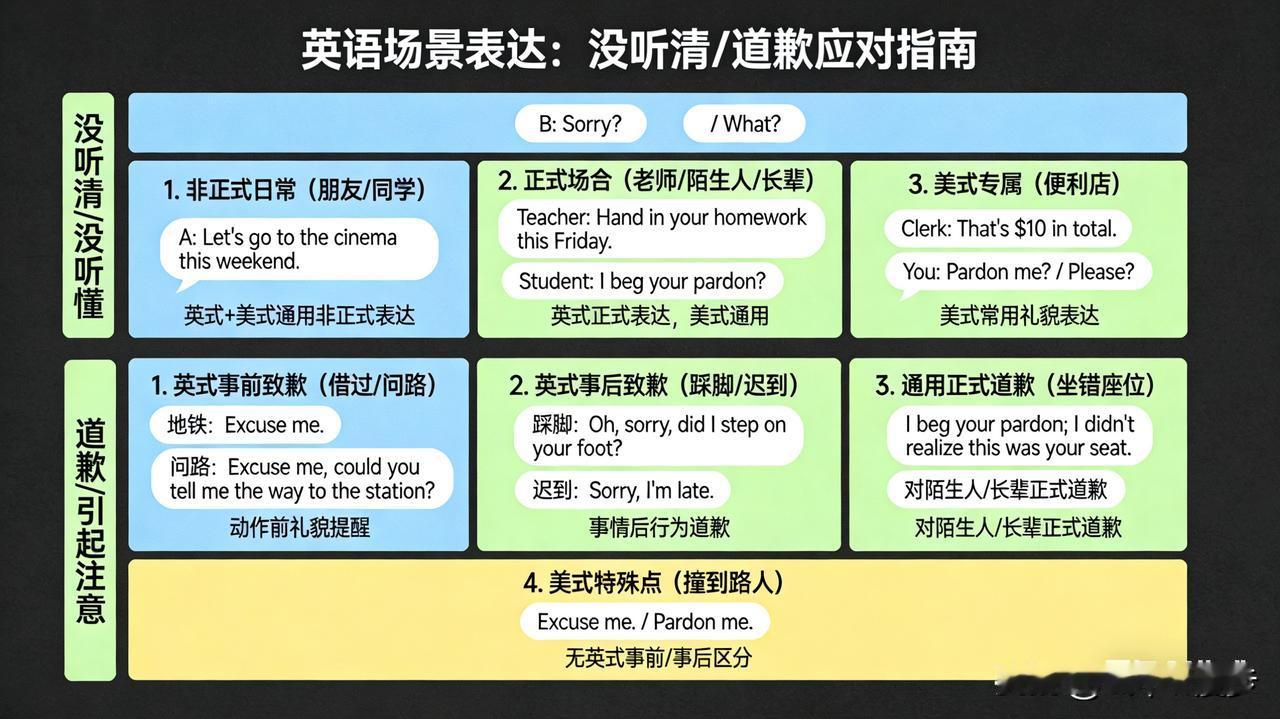
英语学习笔记:Excuse me , sorry , pardon
一、先看「没听清/没听懂」的场景(全用升调❗️)
这是这页补充的核心考点,不同正式程度对应不同场景:
1. 非正式日常(和朋友/同学聊天)
◦ 场景:朋友小声说“周末去看电影”,你没听清
◦ 回应:Sorry? / What?(选一个就行,都是英式+美式通用的非正式表达)
◦ 对话示例:
A: Let's go to the cinema this weekend.
B: Sorry? / What?
A: I said let's go to the cinema this weekend.
2. 正式场合(和老师/陌生人/长辈交流)
◦ 场景:老师开会时说的要求你没听清
◦ 回应:(I beg your) pardon?(英式正式表达,美式也能用)
◦ 对话示例:
Teacher: Hand in your homework this Friday.
Student: I beg your pardon?
Teacher: I said you need to hand in your homework this Friday.
3. 美式英语专属
◦ 场景:在美国便利店买东西,店员说的价格你没听清
◦ 回应:Pardon me? / Please?(美式常用,比What?更礼貌)
◦ 对话示例:
Clerk: That's$10 in total.
You: Pardon me? / Please?
Clerk: I said it's$10 in total.
二、再整合「道歉/引起注意」的场景(区分英式/美式)
结合上一页的知识点,用实例讲清事前/事后致歉的核心区别:
1. 英式英语:Excuse me → 事前致歉/引起注意
◦ 场景1(借过):在地铁上想从人群中穿过 → 说Excuse me.
◦ 场景2(问路):向路人打听车站位置 → 说Excuse me, could you tell me the way to the station?
✅ 核心:动作还没做,先礼貌提醒对方,避免打扰。
2. 英式英语:sorry → 事后致歉
◦ 场景1(踩到人):不小心踩了路人的脚 → 说Oh, sorry, did I step on your foot?
◦ 场景2(迟到):和朋友约会迟到了 → 说Sorry, I'm late.
✅ 核心:事情已经发生,为自己的行为道歉。
3. 英式/美式通用:I beg your pardon → 正式道歉
◦ 场景:不小心坐了别人的座位 → 说I beg your pardon; I didn't realize this was your seat.
✅ 比sorry更正式,适合对陌生人/长辈道歉。
4. 美式英语特殊点
◦ 场景:不小心撞到路人,既可以说Excuse me.也可以说Pardon me.,两者互换都表示道歉,没有英式的“事前/事后”严格区分。